

Wanna know why being bad with money feels like such a life sentence and why it totally throws you down a self-fulfilling prophecy? This post is dedicated to ripping that label off you, even if part of you insists it’s you ‘just being honest’.

Boy, does the pain of bad money management, STING! Every unplanned invoice on your doormat feels personal. Every impulse buy turns into evidence. Meanwhile, you keep replaying old financial messes like a courtroom drama where you’re both the defendant and the judge. And yes, overachievers tend to be extra brutal here, because you expect excellence everywhere and secretly resent yourself when it doesn’t work out that way…
BUT! Contrary to popular belief, calling yourself ‘bad with money’ doesn’t make you accountable. In fact, it starts one heck of a self-fulfilling prophecy that keeps you emotionally stuck. And seriously, it totally defeats the purpose too, because, what overthinkers often want is control, not perfection. Yet this label quietly strips both away by turning temporary behaviour into permanent identity.
What you’re going to learn is why that belief didn’t appear out of nowhere, why it feels so sticky, and why holding on to it is slowing your progress way more than any past mistake could. You’ll also learn how consumer culture thrives on you internalizing blame, instead of questioning the environment you’re navigating.
After you have learned to separate who you are from what you did, you will be able to interrupt impulsive loops, rebuild kick-ass confidence around money, and design strategies that actually stick. As a result, you’ll feel more grounded, more capable, and far more in control of decisions that align with you.
This post is all about those being bad with money beliefs, so you can stop getting yourself trapped in a self-fulfilling prophecy, and instead, start climbing out by taking back control.
Bad With Money
The psychology behind those bad with money beliefs runs deeper than most people dare to look. Because you live inside a consumer culture engineered to trip you at every emotional corner. Ads don’t sell products, but relief, identity, and belonging. Meanwhile, when money feels chaotic, you (and others) scapegoat yourself as the flaw in the system.
On top of that, you confuse being bad with doing something bad. Overspending, impulse buying, or avoidance are misaligned actions; they say something about the action, not about the identity. Yet the self-judgment snowballs, creating shame, guilt, and paralysis. Counterintuitively, that emotional pressure increases impulsivity and ‘bad behaviour’ instead of reducing it.
What I would like you to consider is this: once you restore your identity and align it with innocence, you can finally, actually, focus on the real trigger behind the misstep, and design an environment that supports you. One where levelling up becomes almost inevitable. Because blame only delays and hijacks progress. And strategy? Yeah, that accelerates it.
When “Bad With Money” Becomes a Personality Instead of a Phase
Excuse me for calling it out, but identifying as someone who’s ‘bad with money’ is NOT the same as being self-aware. In fact, I would argue that it’s more like resignation dressed up as honesty. The moment you internalise that label, every future decision gets filtered through it, even before you act.
Self awareness purpose is to focus on cause and effect, so you can get a stronger vision on what you can (and cannot) control. What’s happening here, is that a false, corrupting core belief is being internalised, which then results in you getting stuck in perceived powerlessness, and even financial denial!
RELATED POST:
How To Pull Yourself Out Of Financial Denial: An Overachiever’s Strategy To Get Back In Control
In fact, this is how self-fulfilling prophecies work. You expect failure, so you brace for impact. That tension pushes you into short-term relief behaviours, which then ‘prove’ the story right. And let me tell ya, mass marketing absolutely loves that loop, because discouraged people don’t question systems, they blame themselves.
So. Pause & analyse the situation; you weren’t born mismanaging money. You adapted inside a loud, tempting, emotionally manipulative environment while juggling ambition, stress, goals and self-doubt roundabouts. That context matters more than you’ve been taught.
Let’s refuse to half-ass life by staying loyal to a belief that is designed to keep you small. When you stop confusing behaviour with identity, you reclaim your personal power. And from there, strategy becomes possible again.
Doing Something “Bad” Doesn’t Mean You Are Bad With Money
Sorry for not sugarcoating, but moralising money mistakes is blameful, harmful, and even rigid thinking. Psychology shows us there are actual reasons for your behaviour. You overspent because something inside you wanted relief, reward, or escape. And that doesn’t make you irresponsible!? This is super normal! It makes you a normal, decent, feeling human being navigating the pressure of money management (untaught)!
Counterintuitively, shame doesn’t create discipline. It creates fear, high impulse behaviour & dare I say: survival behaviour! Urgency fuels impulse buying, financial denial, and avoidance. So every time you attack yourself, you strengthen the very patterns you claim to hate.
Instead, take get back in control, try to observe the misstep more from an emotional angle, and more strategically. Ask what emotional need hijacked the moment. Ask what part of your environment made restraint harder than necessary. When you remove judgment, you gain clean information. And seriously: Information is leverage.
This shift is about way more than just money. When you stop outsourcing self-respect to punishment, blame, guilt and shame, you can finally start building healthy boundaries with yourself. And that’s where sustainable change actually starts.
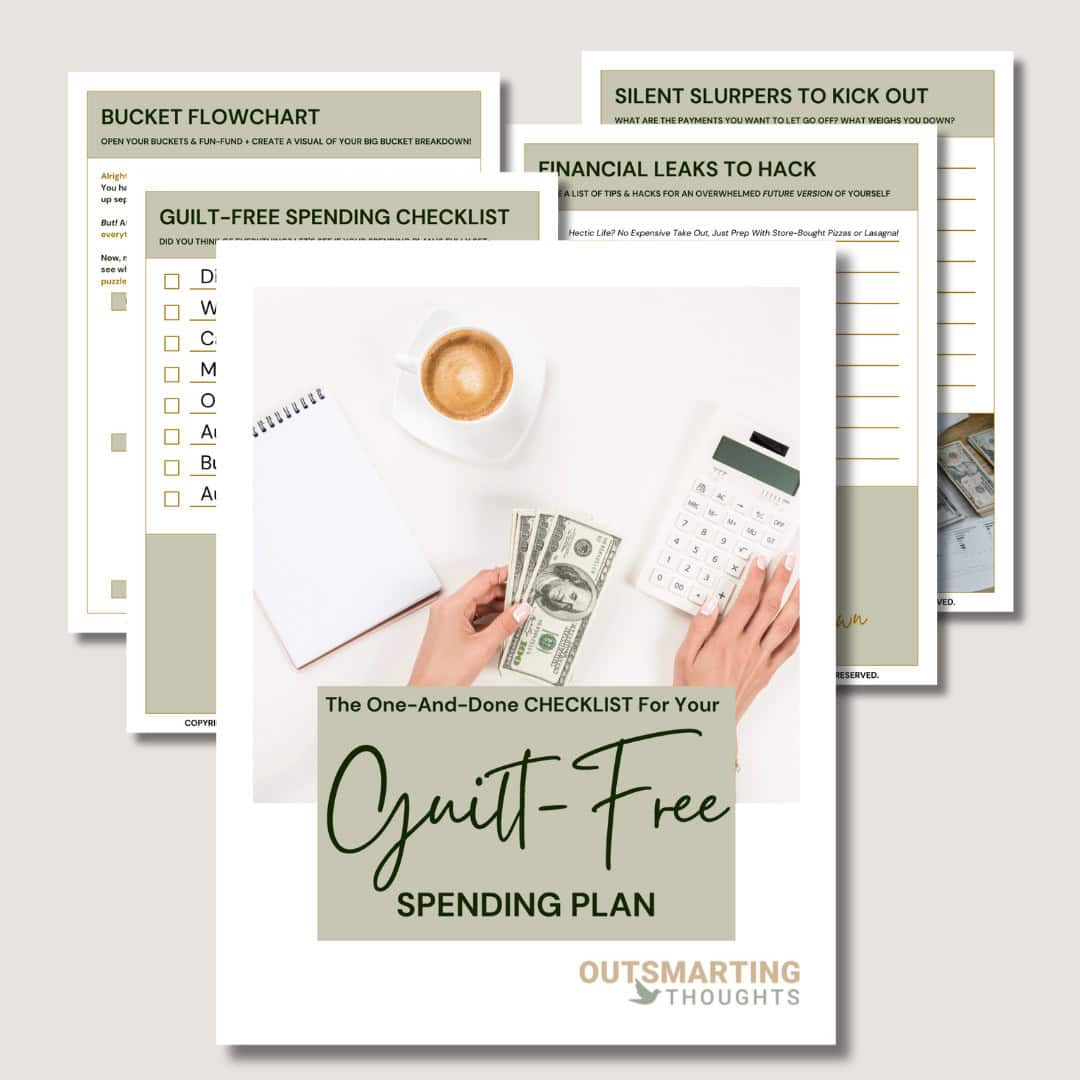
Owning a cashflow strategy is a skill that’ll give you some serious advantages in life. I think budgeting is an aligned action with taking life seriously, and I seriously believe life will reward you for it. If you’re not into high-maintenance strategies like ‘tracking your spending’ and just want to sit down ONCE to direct your financial future, our Guilt-Free Spending Plan Printable is the right cashflow strategy for you! Don’t let anybody outsmart you out of your own money and start budgeting today by simply filling out the form below:
Want a free
ONE-AND-DONE CHECKLIST for aGUILT-FREE SPENDING PLAN? Free up your bandwidth and stop overthinking with this
FREE One-And-Done Checklist for your Guilt-Free Spending Plan!
Simply fill out the form below to get this strategy
delivered straight to your inbox!
Consumer Culture Profits From You Staying “Bad With Money”
Let’s move past fluff & flaky wishful thinking: this societal structure we live in is not neutral, or even there to teach you financial literacy. I can’t hammer on this hard enough, but really, none of this is really your fault!!! Just think about it? Who taught you how to hold yourself up in all this endless firing? And how many times are you approached a day as a consumer? Seriously. It’s NOT your fault. You’re marketed to when you’re tired, insecure, bored, or lonely. And algorithms don’t care about your long-term goals, they care about clicks and conversions.
Yet instead of questioning that setup, you internalise failure. You say ‘I’m bad with money’ and move on, as if that explains anything. It doesn’t. It just protects the machine by redirecting responsibility back onto you. What I would like you to consider is how rebellious it actually is to refuse that narrative. To say: something influenced me, and now I’m responding more strategically. That stance isn’t victimhood, it’s self-leadership.
RELATED POST:
How To Stop Overspending: The Strategy You NEED To Regain Control (Without The Self-Blame Spiral)
When you design friction for impulses and ease for aligned decisions, progress stops being heroic and starts being automatic. That’s how you outgrow patterns without burning yourself down.
Stop Shrinking Your Future to Fit an Old Money Story
Again, excuse me for being so blunt, but clinging to the bad-with-money label is old pain in disguise. It’s time to reclaim your innocence in this dynamic and start observing the cause and effect, instead of falling for the blame game. Only when you leave the internalised belief behind, the one that says that you ‘ARE bad’, can you start changing that very pattern trapping you in despair.
When you drop the judgment, you open space for experimentation. You start tracking whenever you feel like it & can pause before purchases without spiralling. Everything all of a sudden turns into a social science experiment, where your impulsive side is the rat you experiment on, and the scientist is your rational brain, testing new ways of money management. Both parts within you need to work together and care for each other. The goal should be to get a grip, to get back in control, and to finally learn financial literacy instead of condemning yourself.
This is about refusing to half-ass life. About refusing to let your VALUABLE resources, time, money and energy, GO TO WASTE. Not to impress others, but because your time on planet earth deserves intention. You don’t need perfection, you need systems. You don’t need guilt, you need structure.
So go do it! I totally believe in you & your innocence in this. You can start today and try to break out, like an escape from the Matrix! Get a system, get a grip, and get this shit done. That’s how momentum returns.
Bad With Money (Summary)
The psychology behind those bad with money beliefs thrives on misplaced blame. You live in a tempting environment, confuse misaligned actions with identity, and punish yourself into paralysis. That cycle isn’t honesty, but toxic conditioning.
The tools that break it are clear-headed rationality, environmental design, and separating behaviour from self-worth. When you stop moralising money and start analysing triggers, strategy replaces shame.
Picture yourself handling money without drama. Decisions feel grounded. Tracking feels neutral. Impulses lose their grip because your system has your back. And life? Yeah, that feels expansive instead of tight and suffocating.
I wish you the courage to drop the internalised label, the patience to rebuild it more strategically, and the audacity to want more from your life. Go for it!!! You’re capable of way more than this story ever allowed.
This post was all about those being bad with money beliefs, so you can stop getting yourself trapped in a self-fulfilling prophecy, and instead, start climbing out by taking back control.
We aim to help you out as much as possible, but please keep in mind that the content is only for general informational and educational purposes. We offer our services based on independent research and life-experience only, and so our strategies can never serve as a substitute for professional advice. Trust me, we do not have 'everything figured out', are all still huge works in progress, but hey, what works for us, might work for you too! This is allll up for you to decide... It might not work for you, and that's okay, so cherrypick the stuff that resonates and leave the stuff that doesn't, and let's go!