

Wanna know why money doesn’t buy happiness keeps haunting your financial life long after you intellectually agree with it? This post is dedicated to dismantling that belief without sugarcoating, guilt-tripping, or moral grandstanding.

You probably recognise the tension, right? You want freedom, space, and peace of mind, yet you feel oddly ashamed for wanting more money. At the same time, financial stress keeps draining your energy, your focus, and your emotional bandwidth. Overachievers like you often want to do life right, not greedy, not shallow, and definitely not corrupt. Unfortunately, that good intention quietly turns into self-sabotage when money becomes something you avoid, fear, or morally distance yourself from.
What you’re going to learn is why money doesn’t buy happiness is a half-truth that keeps you financially stuck, emotionally dysregulated, and vulnerable to impulse spending. More importantly, you’ll learn how this belief sneaks into your behaviour, your self-judgment, and your money decisions without you noticing.
After you have learned to see money as a neutral tool instead of a moral threat, you will be able to build financial stability without guilt, reduce emotional overspending, and stop outsourcing your power to marketing triggers. Those benefits don’t just improve your bank balance. They restore kick-ass confidence, calm your nervous system, and help you act in ways that actually resonate and align with you.
This post is all about money doesn’t buy happiness, so you can stop staying small, stop moralising survival & the natural struggle of resources, and start using money as a strategic asset instead of an emotional landmine.
Money Doesn’t Buy Happiness
The psychology behind the belief: money doesn’t buy happiness is not noble. In fact, it’s an overcompensation for something way deeper. Money functions like a hammer. You can build a house with it, or you can break one down. It’s not good or evil, it is influenced by the person wielding it. The damage never comes from the tool itself. It comes from the intent, wounds, and emotional baggage of the person holding it.
Yes, power and money often corrupt. That link is real. What rarely gets acknowledged tho, is that trauma is the accelerator, not money itself. When emotional hijacking runs the system, money amplifies whatever is already there. Add to that widespread financial illiteracy, zero education on money management, and a consumer culture designed to tempt you everywhere you turn, and mismanagement becomes the norm rather than the exception.
But beliefs strongly influence our behaviour. And if you believe money is inherently dangerous, you will fear yourself around it. That fear triggers avoidance, self-sabotage, and impulsive relief-seeking. Contrary to popular belief, overspending is rarely about irresponsibility. It’s about unregulated emotions colliding with shame-based money narratives. So let’s explore a little more about this overcompensating belief, shall we?
Money Doesn’t Buy Happiness Is a Half-Truth That Keeps You Powerless
Money doesn’t buy happiness, and that part is true. Millionaires in existential crisis prove that daily. What gets conveniently ignored is that the saying stops right where the real conversation should begin. Happiness is not a luxury product. It’s a byproduct built on safety, autonomy, and emotional regulation.
In fact, money becomes invisible only once you have enough of it. When rent is paid, food is stocked, and emergencies don’t instantly threaten your survival, your nervous system finally exhales. That baseline doesn’t create bliss. It creates stability. And stability is not overrated, despite what motivational posters suggest.
Counterintuitively, repeating that money doesn’t matter often locks you into financial denial. You downplay practical needs, postpone systems, and tolerate stress longer than necessary. Over time, that pressure leaks out sideways. It shows up as impulse buying, avoidance, or self-judgment disguised as morality.
RELATED POST:
How To Pull Yourself Out Of Financial Denial: An Overachiever’s Strategy To Get Back In Control
Let’s not sugarcoat it. Chronic financial stress narrows your thinking. It shortens your fuse. It keeps you reactive. When people dismiss that reality, they confuse virtue with endurance. You’re not enlightened for struggling quietly. You’re paying a psychological price.
What I would like you to consider is this. Money doesn’t buy happiness, but lacking money reliably destroys peace of mind. Ignoring that truth doesn’t make you wiser. It keeps you under-resourced in a system that profits from exactly that.
Wanting Money Is Not Greed, It’s Biological Self-Respect
Outside your window, birds fight for territory, food, and shelter without writing moral essays about it. Naturally, they don’t shame themselves for needing resources. They don’t spiritualize scarcity. They act because survival demands it.
Humans are no different. The difference is that you were taught to moralise basic needs. Wanting money became suspicious, and wanting more than “enough” became selfish. Wanting stability became a character flaw. And let me tell ya, that story benefits everyone except you.
Money is about way more than just comfort. When you observe the pattern more deeply, it’s way more about agency, margin, and choice. Resources give you room to breathe, think, and respond instead of react. That’s not greed. That’s functional adulthood.
Excuse me being frank, but I absolutely resent wishful thinking, and this is wishful thinking. Pretending you can transcend material reality through mindset alone is denial dressed up as wisdom. You don’t become less human, or less ‘good-natured’ by wanting stability. You become less vulnerable to chaos.
Once you drop the shame, money stops being a threat. It becomes infrastructure for the life you actually want to live.
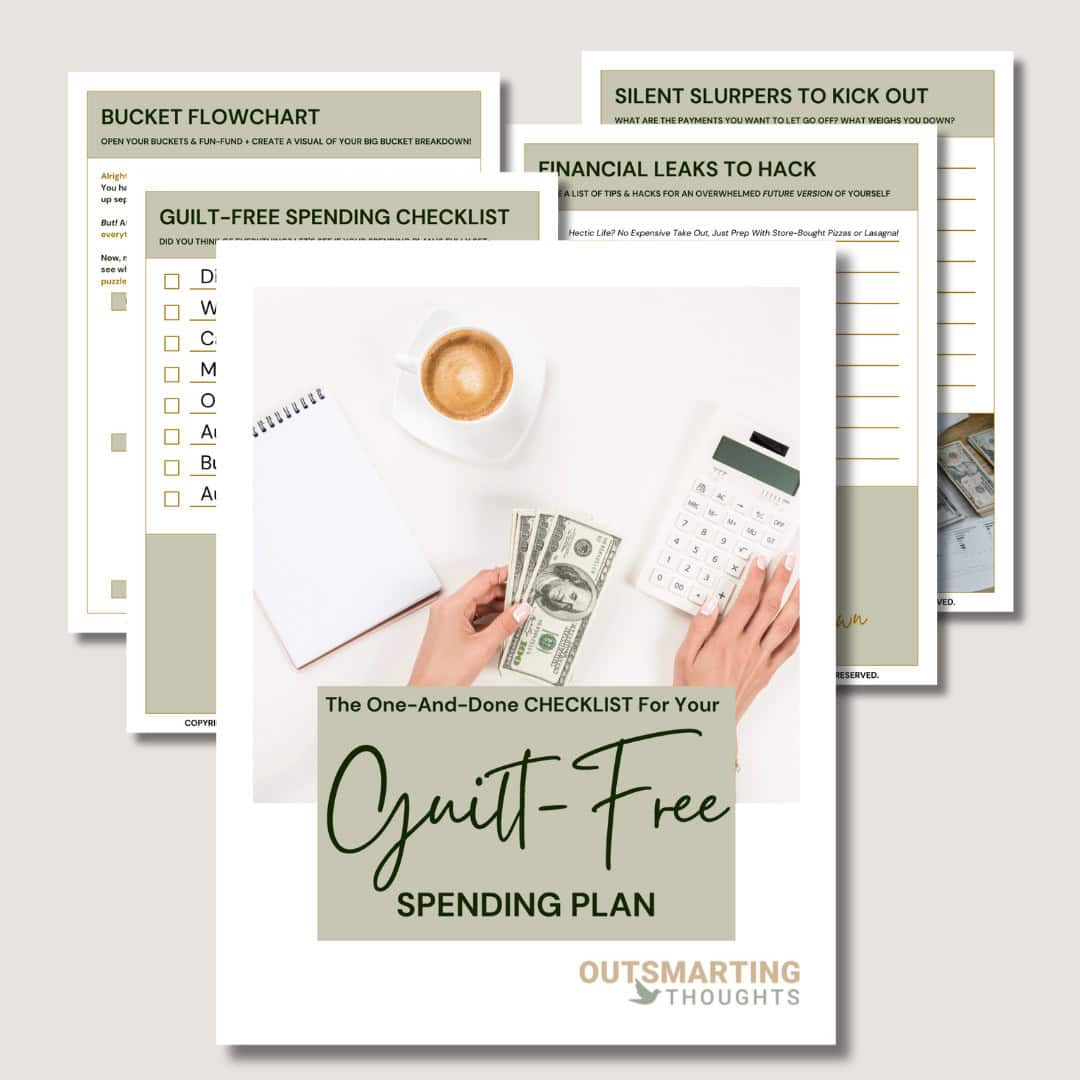
Owning a cashflow strategy is a skill that’ll give you some serious advantages in life. I think budgeting is an aligned action with taking life seriously, and I seriously believe life will reward you for it. If you’re not into high-maintenance strategies like ‘tracking your spending’ and just want to sit down ONCE to direct your financial future, our Guilt-Free Spending Plan Printable is the right cashflow strategy for you! Don’t let anybody outsmart you out of your own money and start budgeting today by simply filling out the form below:
Want a free
ONE-AND-DONE CHECKLIST for aGUILT-FREE SPENDING PLAN? Free up your bandwidth and stop overthinking with this
FREE One-And-Done Checklist for your Guilt-Free Spending Plan!
Simply fill out the form below to get this strategy
delivered straight to your inbox!
Why Blaming Money Keeps You Trapped in Overspending Loops
When money feels dangerous, you subconsciously avoid mastery. That avoidance doesn’t make you virtuous, but reactive. Financial turbulence rarely comes from ‘being bad with money’. It comes from emotional hijacking layered on top of zero education.
RELATED POST:
Bad With Money? Congrats, You’ve Been Gaslit By Consumer Culture
Consumer culture is engineered to exploit your nervous system. Triggers everywhere. Urgency everywhere. Identity everywhere. Then, when you overspend, you turn inward and decide the problem must be you. Or worse, money itself.
Here’s the crucial distinction you were never taught. Doing something misaligned is not the same as being misaligned. Overspending is a behaviour, not a verdict on your character. When you collapse those two, shame multiplies the problem.
Pause and analyse the situation. Impulse buying often functions as emotional relief. It regulates stress temporarily, or at least, that’s the FUNCTION of the behaviour. But the relief fades. And because you internalise & identify with the behaviour? Guilt steps in. Then comes another attempt to escape discomfort. That loop has nothing to do with happiness and everything to do with unprocessed pressure.
Blame, shame, and guilt don’t stop impulsivity. They feed it. Once you restore your innocence and recognise the environment you’re operating in, strategy becomes possible. And strategy, unlike shame, actually changes outcomes.
Stop Staying Small for a System That Profits from Your Self-Doubt
Mass marketing doesn’t want you empowered. It wants you reactive, distracted, and slightly dissatisfied. A person who believes money corrupts will never fully claim financial agency. That belief keeps you consuming emotionally instead of managing strategically. How convenient…
Beliefs shape behaviour long before logic enters the room. If you fear that money will turn you into a bad person, you’ll unconsciously sabotage growth. You’ll avoid systems & delay decisions. You’ll stay in the self-doubt roundabout while calling it humility.
Money management is not mystical. It’s logical. It’s learnable. And contrary to popular belief, you don’t need decades to improve it. Set up a small, intentional plan, and you’re already ahead of most people who avoid the topic entirely.
This is about way more than just money. When you stop moralising resources, you reclaim agency. You stop outsourcing your power to impulses and narratives designed to keep you small. You start building a life that actually resonates and aligns with you.
Refusing to half-ass life is not arrogance. It’s high-value, dignified and a form of self-respect.
Money Doesn’t Buy Happiness (Summary)
The psychology behind money doesn’t buy happiness reveals a defensive belief system, that is based on overcompensating for the sake of misinterpreted morality. Money is a tool, like a hammer. Trauma, emotional hijacking, and financial illiteracy determine whether that tool builds or destroys. When money becomes the scapegoat, fear replaces mastery, and self-sabotage quietly follows.
The tools you’ve seen here focus on separating behaviour from identity, restoring innocence after missteps, and replacing shame with strategy. By treating money management as a practical skill rather than a moral battlefield, you reduce impulsivity, increase agency, and regain clear-headed rationality.
Picture a future where money no longer controls your mood, your decisions, or your self-image. You act deliberately & choose intentionally. You build systems that support your energy instead of draining it. This world can be yours, as long as you allow yourself to step into it…
I wish you the courage to stop playing small, the grit to master what scares you, and the audacity to fully live the life you came here to live. You deserve nothing less <3 Go get it.
This post was all about money doesn’t buy happiness, so you can stop staying small, stop moralising survival & the natural struggle of resources, and start using money as a strategic asset instead of an emotional landmine.
We aim to help you out as much as possible, but please keep in mind that the content is only for general informational and educational purposes. We offer our services based on independent research and life-experience only, and so our strategies can never serve as a substitute for professional advice. Trust me, we do not have 'everything figured out', are all still huge works in progress, but hey, what works for us, might work for you too! This is allll up for you to decide... It might not work for you, and that's okay, so cherrypick the stuff that resonates and leave the stuff that doesn't, and let's go!