
Wanna know why procrastination stress and anxiety feel so much heavier than the task itself? This post is dedicated to everyone who keeps pushing themselves harder while silently drowning in mental noise, self-doubt roundabouts, and a constant sense of pressure they can’t quite name.

You don’t procrastinate because you don’t care. You procrastinate because you care deeply, and maybe even too deeply. While the world loves to frame procrastination as laziness, you feel the burden in your bones; the stress never leaves you alone. It hums in the background while you try to catch a breath. It taps on your shoulder when you want to sleep. And it steals your joy even on your “free” days.
What you’re going to learn is why procrastination stress and anxiety have very little to do with discipline, and almost everything to do with how your brain handles unfinished business. More importantly, you’ll learn why holding everything in your head slowly drains your sense of self-worth, power, and kick-ass confidence.
After you’ve learned how procrastination stress and anxiety actually work beneath the surface, you’ll be able to stop blaming yourself, stop shrinking your ambition out of pride protection, and start working more strategically with your mind instead of against it. That shift alone gives you back energy, authority over your time, and a grounded sense of self-alignment.
This post is all about procrastination stress and anxiety, so you can stop carrying that gnarly invisible weight and start living like someone who refuses to half-ass life.
Procrastination Stress and Anxiety
Procrastination stress and anxiety don’t come from avoiding tasks; I would argue that they come from trying to hold your entire life inside your head. Your brain is brilliant at problem-solving, pattern recognition, and creativity. However, it was never designed to function as long-term storage for obligations, decisions, and unresolved commitments. When you don’t externalise what you need to do, your mind stays on high alert, scanning constantly for what might be forgotten.
This is where stress quietly morphs into anxiety. Not because you’re weak, but because your nervous system doesn’t feel safe and rest-assured. Open loops create tension. Unclear outcomes create pressure. And the shadow part of you, the one shaped by shame, blame, and past overwhelm, steps in to protect you by delaying action. Procrastination isn’t failure; it’s a subconscious safety strategy that has simply outlived its usefulness.
Your Brain Was Never Meant to Hold Open Loops
Procrastination stress and anxiety explode the moment your brain becomes a storage unit instead of a command center. Every unfinished task you keep “mentally bookmarked” demands attention. Not loudly, but persistently. That low-grade tension you feel isn’t drama; it’s your nervous system refusing to trust your memory.
RELATED POST:
How To Cope With Being Overwhelmed: The Case For Taking Back Control
When you try to remember everything, your mind can’t rest. Instead, it keeps reopening the same loops, nudging you with vague unease. You’re not thinking clearly; you’re guarding information. That guarding state drains energy fast, which explains why you feel exhausted before you even start.
What makes this especially painful for overachievers is unnecessary independence out of pride. Somewhere along the line, you learned that needing systems meant weakness. That competent people just “keep track of things.” So you carry more than you should, quietly proving your worth through endurance. What it truly is about, though, is a slow erosion of self-respect. You’re asking your mind to do a job it was never designed to do, and are then criticising it when it struggles.
The moment you externalise a task, something shifts. Your body exhales. Your thoughts slow down. Not because the work vanished, but because your brain finally feels safe enough to stop monitoring it. That’s not productivity magic. That’s nervous system relief.
Why Avoiding the To-Do List Feels Safer Than Facing It
Procrastination stress and anxiety often spike right before you write things down. That’s not accidental. Externalising a task forces clarity, and clarity forces confrontation. Suddenly, the vague monster becomes specific. Suddenly, a decision is required. Anxiety doesn’t like that.
If you’ve ever avoided your planner while doom-scrolling, this is why. Writing something down turns pressure into reality. And if you’ve been conditioned through guilt or shame to associate performance with worth, that reality can feel threatening. Your subconscious isn’t lazy; it’s protective.
This is where dignity and self-respect come in. Avoidance isn’t about defiance; it’s about fear of failing yourself again. Every unfinished promise echoes old narratives about not being enough. Overachievers & overthinkers are sooooo sensitive to this paradigm, it threatens them to the core. So the shadow steps in and says, “Not now. Later. Tomorrow.” It thinks it’s helping you survive.
What I would like you to consider is that procrastination stress and anxiety ease when you stop arguing with that part of yourself and start working with it. It is there to protect you! So try working with it as if it’s a lost child, or a traumatised, damaged part of you.. Externalisation isn’t pressure; it’s containment. It tells your nervous system, “You’re not alone with this anymore.”
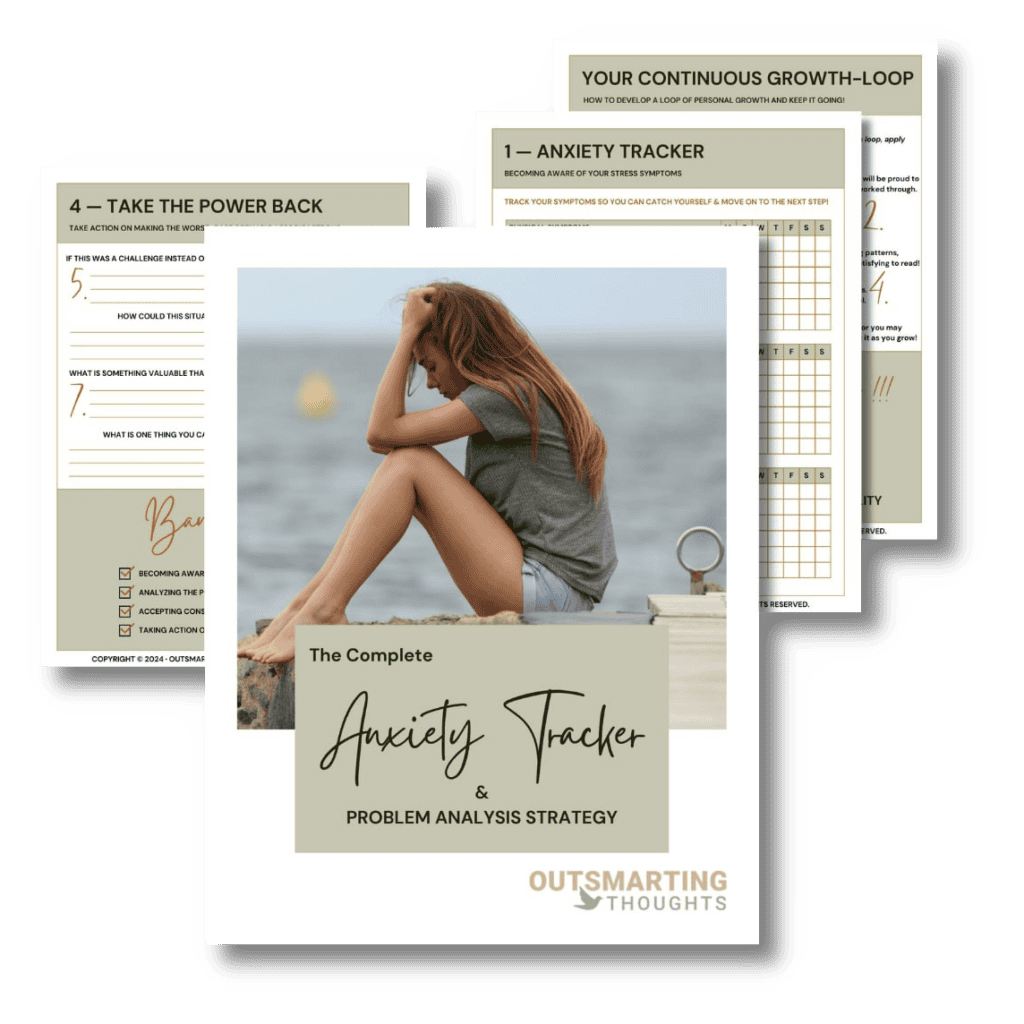
Let’s make managing stress & anxiety a little bit more practical by diving into our problem analysis strategy. There’s a solution to every problem! You’ll feel extremely relieved once you have a strategy to get out of the messy parts. We made a printable & anxiety tracker to help you out. Simply fill out the form below:
Want a free
ANXIETY TRACKER &PROBLEM ANALYSIS STRATEGY? Overcome your anxiety and stop overthinking with this
FREE Anxiety Tracker & Problem Analysis Strategy
Simply fill out the form below to get this strategy
delivered straight to your inbox!
How Procrastination Turns Stress Into Anxiety Over Time
Stress is a response to demand. Anxiety is stress without an endpoint. Just like pain is natural, but suffering is optional, we would like to be able to only deal with the necessary pain & stress, and weed out the suffering and the anxiety. How? When tasks live only in your head, there is no finish line. Everything feels urgent, yet nothing feels doable. That’s the perfect breeding ground for self-doubt roundabouts.
RELATED POST:
Owning Your Power: 7 Telltale Signs Of An Overachiever In Control
Your mind keeps scanning for danger. Your body stays activated. Meanwhile, you start questioning your competence, not realising the environment INSIDE your head has become unorganised and overwhelmingly hostile. This is how procrastination quietly chips away at dignity. Not through failure, but through constant inner self-condemning.
Here’s the contradiction most people miss. Google Carol Dweck if you want to fall down the science part of this rabbit hole! You don’t procrastinate because you don’t care; you procrastinate because you care so much that the cost of engaging feels too high. Anxiety isn’t telling you to stop; it’s telling you the system you’re using needs adjustment.
When you externalise tasks, you create psychological distance. That distance allows rational prioritisation instead of emotional hijacking. You stop reacting from a fear-based state and start responding from self-control and agency. And that’s where stress loses its grip.
Externalizing Is About Power, Not Productivity
Procrastination stress and anxiety dissolve fastest when you stop framing systems as productivity tools and start seeing them as power tools to stay in a place of self-control. Writing things down isn’t about becoming efficient. It’s about reclaiming authority over your inner world.
A trusted system gives your mind permission to rest. It replaces mental guarding with strategic choice. You’re no longer reacting to pressure; you’re engaging with intention. That’s where kick-ass confidence grows, not from forcing yourself, but from knowing you have your own back.
This is also where dignity lives. When you stop relying on brute mental force, willpower and discipline, you stop shrinking yourself. You stop performing competence and start practising self-leadership. That shift doesn’t make you smaller; it makes you formidable.
Nobody is coming to save you. But the moment you externalise your commitments, you stop needing rescue. You become the one in charge again. Calm. Clear-headed. Unapologetically ambitious. The NATURAL state of an overachiever, I dare say 😀
Procrastination Stress and Anxiety (Summary)
Procrastination stress and anxiety aren’t caused by poor discipline or weak character. They’re the result of asking your brain to carry what should be contained externally. When tasks stay trapped in your head, stress turns into anxiety, and anxiety invites your shadow to take the wheel.
The core strategy you’ve learned here isn’t “do more.” It’s offload first, then decide. Externalise tasks to create mental safety. Use systems to protect your nervous system. Let structure do the heavy lifting so your mind can do what it does best.
Picture a future where your thoughts feel lighter, your energy steadier, and your ambition no longer tangled with guilt. You move through your days with authority and full attention, not urgency and feeling stressed out. You don’t shrink your goals; you meet them strategically.
I wish you the courage to stop proving your worth through suffering, and the audacity to build a life that actually supports your greatness. Go take your place. You’re ready.
This post was all about procrastination stress and anxiety, so you can stop carrying that gnarly invisible weight and start living like someone who refuses to half-ass life.
We aim to help you out as much as possible, but please keep in mind that the content is only for general informational and educational purposes. We offer our services based on independent research and life-experience only, and so our strategies can never serve as a substitute for professional advice. Trust me, we do not have 'everything figured out', are all still huge works in progress, but hey, what works for us, might work for you too! This is allll up for you to decide... It might not work for you, and that's okay, so cherrypick the stuff that resonates and leave the stuff that doesn't, and let's go!