

Wanna know how to stop taking financial stress so damn personal and finally break the toxic belief that you’re somehow a failure with money? This post is dedicated to dismantling the shame narrative that keeps intelligent, driven people stuck in financial self-doubt.

Financial stress hits differently when you’re an overachiever. You expect yourself to be capable. You expect yourself to handle life. Yet when money feels messy, it suddenly feels like proof that something is wrong with you. That internal voice whispers that you should have figured this out already. And let me tell ya, that voice can be brutal. Seriously, who doesn’t DETEST feeling incompetent? Therefore, money problems don’t just feel inconvenient. They feel like a verdict about your character. Instead of seeing financial stress as a solvable situation, your brain turns it into a personal failure.
What you’re going to learn is how to dismantle this belief completely. More importantly, you’ll understand why financial stress has far more to do with financial illiteracy, consumer culture, and psychological triggers than with YOUR intelligence or discipline.
After you have learned to stop interpreting money problems as a character flaw, you will be able to analyse your finances with far more clear-headed rationality. As a result, you can create goals that resonate with you, design a budgeting strategy that actually fits your personality, and rebuild kick-ass confidence in your ability to manage money strategically. Because your hard-earned cash SHOULD be in your control!
This post is all about dismantling the overidentification of financial stress, so you can stop attacking yourself and start taking control of your financial life with self-empowerment & strategy.
Financial Stress
Financial stress has a nasty psychological twist. You rarely treat it like a logistical issue. Instead, you treat it like proof of personal failure. Contrary to popular belief, money itself is not the villain here. Money is a tool. Think of it like a hammer. A hammer can build a house or destroy a window. The difference is always the intention of the person holding it.
Yet culture loves telling dramatic stories about money corrupting people. Of course, power and money can amplify ugly behaviour; let’s not go into full denial there. However, the real driver behind most financial chaos is not money itself. It is trauma, emotional triggers, and financial illiteracy. Nobody teaches you how money works. Meanwhile, advertisements, social media, and entire industries tempt & trigger your nervous system to spend.
Pause & analyse the situation; blaming yourself for struggling in that environment is like blaming yourself for slipping on ice while someone keeps throwing water on the sidewalk. Financial stress, therefore, is not proof that you are incapable. It is a signal that you were never properly equipped for a system designed to tempt you nonstop. We’re talking foul play.
Realise This First: Financial Stress Is Not Proof You’re A Failure
Financial stress feels personal because your brain interprets it like a verdict. A late bill suddenly becomes evidence that you’re irresponsible. A credit card balance suddenly becomes proof that you’re bad with money. Your mind jumps straight from action to identity. The shoulds just keep piling up: I should have done this, I should have done that.
Doing something misaligned quickly turns into believing you are fundamentally flawed. However, that mental leap is wildly inaccurate, and deeply unkind to yourself, I might add. Overspending, impulse buying, or financial avoidance are behaviours. They are actions. They are not a personality trait.
When you confuse doing something bad with being bad, the shame spiral starts. Instead of fixing the problem (the behaviour), you start attacking yourself. Ironically, that self-punishment makes things worse, and even can lead to full financial denial!
RELATED POST:
How To Pull Yourself Out Of Financial Denial: An Overachiever’s Strategy To Get Back In Control
Contrary to popular belief, financial stress does not happen in isolation. It’s not YOU! You live inside a consumer culture engineered to provoke spending. Ads interrupt your thoughts. Discounts create urgency. Social media constantly flashes lifestyles that look better than your own. Every corner of modern life nudges you to buy something. Excuse me for being frank, but pretending that the environment has no influence is absurd. And how convenient!?
Nobody teaches you how to manage money. Schools rarely explain budgeting. Most families also never learned financial strategy themselves. Therefore, you inherit confusion, trial and error, and a lot of emotional noise around money. Meanwhile, the marketing industry spends billions studying human psychology so it can push you toward spending faster.
So before you accuse yourself of failure, pause. You are not failing a simple game. You are navigating a chaotic system without proper training. Again, this is foul play! Cut yourself some slack!
Responsibility Starts With Education, Not Self-Punishment
Realising something is not your fault does not mean staying stuck, or excusing bad behaviour. What I would like you to consider is that growth begins the moment you replace blame with taking responsibility. You need to know what’s within your control to change the pattern, and aim for growth through education.
Financial autonomy starts with knowing what you actually want. Sorry for not sugarcoating, but many people sabotage themselves by copying financial goals that do not even resonate with them. They try to save aggressively because someone said they should. Then resentment builds. Eventually, they subconsciously rebel against their own budget. That pattern has nothing to do with discipline. It has everything to do with abandoning your authentic desires.
Financial goals must authentically align with your life to work! You are allowed to want beautiful things. You are allowed to want comfort, travel, security, or creative freedom. However, those desires must become conscious goals instead of impulsive decisions. Once that alignment exists, budgeting stops feeling like punishment. Instead, it becomes a strategy.
The second piece is choosing a budgeting method that fits your personality. Some people love tracking every expense. Others need a simple system they set up once and barely touch again. Financial autonomy, therefore, means having choice. You design a system that supports your goals instead of constantly fighting your habits.
Owning a cashflow strategy is a skill that’ll give you some serious advantages in life. I think budgeting is an aligned action with taking life seriously, and I seriously believe life will reward you for it. If you’re not into high-maintenance strategies like ‘tracking your spending’ and just want to sit down ONCE to direct your financial future, our Guilt-Free Spending Plan Printable is the right cashflow strategy for you! Don’t let anybody outsmart you out of your own money and start budgeting today by simply filling out the form below:
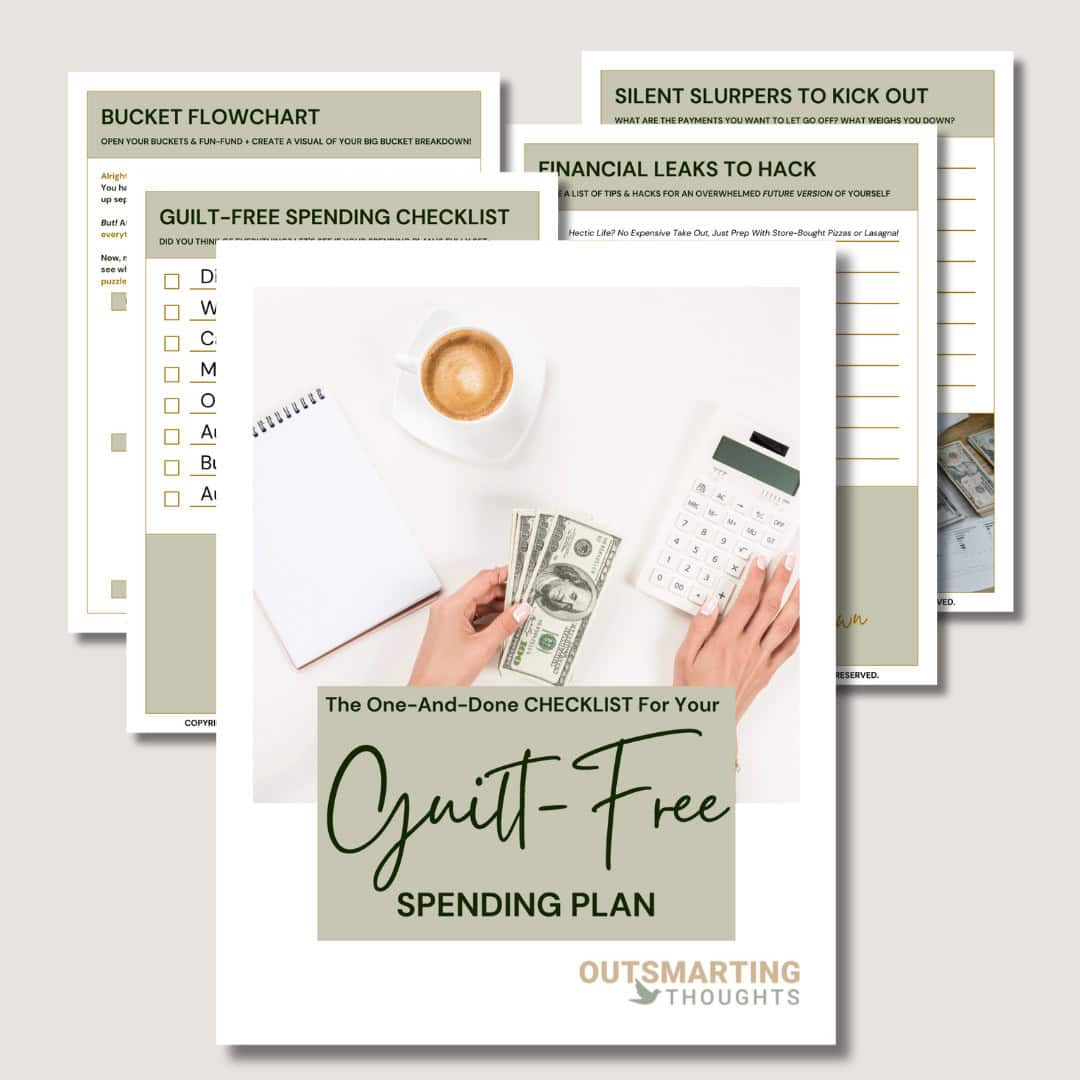
Want a free
ONE-AND-DONE CHECKLIST for aGUILT-FREE SPENDING PLAN? Free up your bandwidth and stop overthinking with this
FREE One-And-Done Checklist for your Guilt-Free Spending Plan!
Simply fill out the form below to get this strategy
delivered straight to your inbox!
Self-Blame Feels Good For A Second But It Freezes Your Growth
Blame has an odd psychological effect. For a brief moment, blaming someone feels relieving. The mind thinks it has solved the mystery. If the problem has a culprit, the story feels complete. Unfortunately, the same trap appears when you blame yourself.
The moment you decide you are simply bad with money, the investigation stops. No strategy appears. No growth happens. The story ends with a painful but convenient conclusion. And let me tell ya, that conclusion is incredibly seductive. Self-blame feels honest. It feels responsible. Yet it quietly locks you into repeating the same financial patterns again and again.
Counterintuitively, responsibility requires the opposite move. It starts with knowing who you are and what you want, so you can learn what intentional spending is all about! Responsibility begins when you refuse to obsess over blame and instead focus on influence. Pause & analyse the situation; what part of this pattern is within your control?
RELATED POST:
Intentional Spending: The CEO-Mindset And AntiDote Against Overspending & Impulse Buying
Maybe you need clearer financial goals. Maybe your environment triggers impulse buying, or maybe your budgeting strategy does not match your personality. What about just deleting the shopping apps from your phone? Those questions create movement. Blame creates paralysis. Excuse me for being frank, but constantly repeating the sentence ‘I’m just bad with money’ is nothing more than psychological quicksand.
Instead, push that useless narrative aside. Treat it like background noise from a bad teacher. Then shift your attention toward strategy. Because once you focus on actions you can control, financial stress stops feeling like a personal attack and starts looking like a solvable puzzle.
The Real Work Happens When You Investigate Your Triggers
Taking financial stress personally often has deeper roots. Money triggers emotions quickly. Fear, shame, and guilt appear before rational thinking has time to intervene. That reaction rarely started with money itself. Often, the pattern began much earlier.
Think about the environment you grew up in. Was blame common? Did mistakes lead to harsh criticism? Did adults react to problems with anger or punishment? If that atmosphere existed, your brain learned something powerful. It learned that mistakes equal danger. Years later, financial mistakes can trigger that same emotional alarm system. The adult situation becomes tangled with childhood echoes. Suddenly a budgeting error feels like proof you deserve punishment. However your younger self was not a failure. Your younger self was an innocent child navigating a complicated environment. That same compassion deserves to exist now.
What I would like you to consider is replacing self-punishment with curiosity. Instead of attacking yourself after a financial misstep, investigate the trigger. Were you exhausted? Were you stressed? Did the purchase promise relief or comfort? Understanding those signals gives you strategic leverage. Once triggers become visible, you can respond differently.
Maybe you reward progress through dopamine dosing. Maybe you build healthier emotional coping strategies, or maybe you design your environment so temptations appear less often. All those changes shift the pattern. And suddenly, financial growth stops feeling like punishment and starts feeling like reclaiming your power.
Financial Stress (Summary)
Financial stress becomes destructive when you interpret it as proof of personal failure. Money itself is simply a tool, similar to a hammer. When problems appear, the real drivers are usually financial illiteracy, emotional triggers, and a consumer culture designed to provoke spending.
The strategy therefore, begins by restoring your innocence and shifting your focus toward growth. Educate yourself about money. Define financial goals that resonate with you. Choose a budgeting strategy that fits your personality. Investigate emotional triggers instead of attacking yourself.
Imagine how different life feels once financial stress stops controlling your self-image. Decisions become calmer. Spending becomes intentional. Money slowly turns into a tool that supports the life you refuse to half-ass.
I wish you the courage to rebel against shame, the discipline to design your own strategy, and the thrill of building a financial life that actually excites you.
This post was all about dismantling the overidentification of financial stress, so you can stop attacking yourself and start taking control of your financial life with self-empowerment & strategy.
We aim to help you out as much as possible, but please keep in mind that the content is only for general informational and educational purposes. We offer our services based on independent research and life-experience only, and so our strategies can never serve as a substitute for professional advice. Trust me, we do not have 'everything figured out', are all still huge works in progress, but hey, what works for us, might work for you too! This is allll up for you to decide... It might not work for you, and that's okay, so cherrypick the stuff that resonates and leave the stuff that doesn't, and let's go!